
India's leading strategic thinker and analyst, Brahma Chellaney has won the 2012 Asia Society Bernard Schwartz Book Award for his recently published book Water: Asia's New Battleground.

"The increasingly vocal China-Japan feud, the not-so-veiled Sino-Indian rivalry and the growing concerns in Asia over China's rising power make the future course of Asian security uncertain," says Brahma Chellaney in his book.

The delegations from the US and Iran head to Islamabad on Friday, carrying a ceasefire that is already fraying, a Strait that is technically open and practically closed, and a negotiating agenda that would challenge even parties actually negotiating in good faith, which these groups are not. Prem Panicker continues his must read blog on the Iran War.
'Now the onus has to be on the US to start delivering.'
From the resurrected cash-for-votes scandal to a rigged process favouring four foreign vendors -- and from new safety concerns to the special legislation that caps the foreign suppliers' accident liability by burdening the Indian taxpayer -- the nuclear deal's future looks more troubled than ever, says Brahma Chellaney.
By staying engaged in the useless border talks, knowing fully well that Beijing has no intent to settle territorial issues, India gives greater space to China to mount strategic pressure and gain leverage, notes strategic expert Brahma Chellaney.
'Given Beijing's growing hardline stance towards India since 2006, New Delhi's attempt to sweep serious issues under the rug is baffling,' says Brahma Chellaney.
'A prosperous, militarily strong China cannot but be a threat to its neighbours, especially if there are no constraints on the exercise of Chinese power.'
'More than a decade after Pokharan II, India doesn't have much to celebrate. It still doesn't have minimal, let alone, credible deterrence,' says Brahma Chellaney.
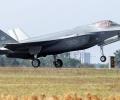
Two Elon Musk from November 2024 surfaced online over the weekend in which he can be seen criticising the US' F-35 fighter aircraft which President Donald J Trump offered to sell India during Prime Minister Narendra D Modi's visit to the White House on Thursday.
'It will be a double tragedy for Sri Lanka if making peace proves more difficult than making war,' says Brahma Chellaney.
'What Nehru valued most of all was the attempted construction of a plural, open, and democratic polity working for change in the lives of all citizens,' says biographer Judith Brown.
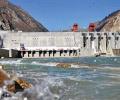
The mighty Brahmaputra, one of the longest rivers in the world passes through China, India and Bangladesh and has several tributaries and sub-tributaries.

To mark Prime Minister Modi's seventh meeting with Obama and his historic joint address to US Congress -- the sixth Indian PM to do so -- India Abroad, the newspaper published from New York and owned by rediff.com, reached out to diplomats and strategic thinkers in New Delhi and Washington, DC, to assess the current state of the US-India relationship and suggest a road map for the future.

'Is it because they perceive India as a soft state?'

India and Japan have a shared interest in countervailing China's hegemonic ambitions in Asia. Although neither has an interest in forming an overt anti-China alliance, Tokyo and New Delhi feel increasingly obligated to work together to find ways to guard against a muscular Beijing's power sliding into arrogance, says Brahma Chellaney.
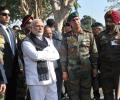
'The attack on the Pathankot base constituted an act of war. Yet Modi's only public comment up until now on that attack has been to blame it on "enemies of humanity".' 'Modi came to power talking tough about Pakistan. But in office, he has pursued a Pakistan policy that has lost both direction and purpose,' argues Brahma Chellaney.

Just like China wants Trump to lose the US presidential poll, it may want Modi to lose the Lok Sabha polls. So months before the 2024 elections, China may take possession of an important area, say one of the Char Dhams, warns Sanjeev Nayyar.

'After many rudderless years, India and Japan have prime ministers with a sense of purpose and direction,' says Brahma Chellaney.
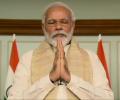
In a statement, the Prime Minister's Office (PMO) said the focus of Modi's remarks at the meeting on Friday was the events of June 15 at Galwan that led to the loss of lives of 20 Indian military personnel.

The only thing that may salvage Narendra Modi's trip to the US is his meetings with CEOs, such as those of Blackstone, First Solar, Qualcomm, Adobe, and General Atomics, asserts Rajeev Srinivasan.

To mark his 50th death anniversary, rediff.com has launched a special series to evaluate Jawaharlal Nehru's legacy.

'China has gone too long as a rogue power, trashing international norms, agreements, and treaties as if they were not the paper they were written on.' 'The ill-advised attack on Ladakh may be the beginning of the end of that nonsense,' advocates Rajeev Srinivasan.
Indians must remember that Pakistanis hate losing to India, at war or in cricket, says Sanjeev Nayyar.

Japan has the capital and needs to pull out of China, which has been its major destination. India, on the other hand, desperately needs capital especially for infrastructure, argues Rajeev Srinivasan.

'Until India fully absorbs the fundamentals of international relations, it will continue to get evil for good,' says Brahma Chellaney.

President Obama had no intention of risking a global conflagration on account of the use of chemical weapons in Syria, especially at a time when he was struggling to wind up the wars his predecessor had started, says T P Sreenivasan

'There are three issues related to beef consumption and cow slaughter. One is the British origin of cow slaughter. Two, if slaughter of cows is sanctioned by Islamic scriptures and three, the environmental impact of beef consumption.'

'As in the Panchatantra tale of the cat and the monkeys, it is possible for the clever swing State to play off the two competing powers.'

'We need to be in a perpetual state of aggression, and able to swiftly change the goal posts to keep Pakistan in a state of imbalance,' argues Sanjeev Nayyar.

'Chinese leaders rarely receive their foreign guests in cities other than Beijing. Such respect for India!' 'Does it mean that Modi could replicate "the warmth and unconventional way" by sending Indian troops into Tibet, as Xi did in Chumur (Ladakh) when he arrived in India? Of course, Indians are far too polite to do so,' says Claude Arpi.
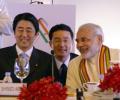
'Both nations have a common problem: A rampaging, jingoistic and hostile China which is making substantial territorial claims. In the long run, Japan and India are going to be the victims of Chinese aggression -- so they might as well hang together to contain China,' argues Rajeev Srinivasan.
